
The Challenge
In traditional container trucking, tractors often remain attached to trailers while containers are loaded or unloaded. This ties up valuable tractor capacity and limits the number of jobs a fleet can handle.
Drop-and-pull operations allow tractors to leave trailers behind and move on to their next assignment, but coordinating tractors, trailers, yards, and customer time windows creates a complex optimization challenge.
Why Our Solution Is Different
Unlock Capacity with Drop-and-Pull
- Compares traditional tractor-trailer operations with drop-and-pull dispatch, where tractors keep working while trailers stay at customer sites
- Shows how operational flexibility changes fleet requirements, utilization, and costs
Keep tractors moving, not waiting.
Two-Speed Optimization
- Plan Now (seconds): local-search optimization for fast planning decisions
- Plan for Tomorrow (minutes): Adaptive Large Neighborhood Search (ALNS) explores more alternatives to seek higher-quality plans
- Different planning horizons call for different optimization strategies
Fast when time matters. Deeper when savings matter.
Economics-First Decision Intelligence
- Compares strategies on one consistent cost model: tractor and trailer costs, driver time, fuel, outsourcing, and service penalties
- Explores fixed-fleet scenarios and the fleet capacity required to complete the same workload
Optimize the economics, not just the distance.
Independently Verified Optimization
- All optimization methods are evaluated by a shared, independent verifier that checks feasibility and calculates operational metrics
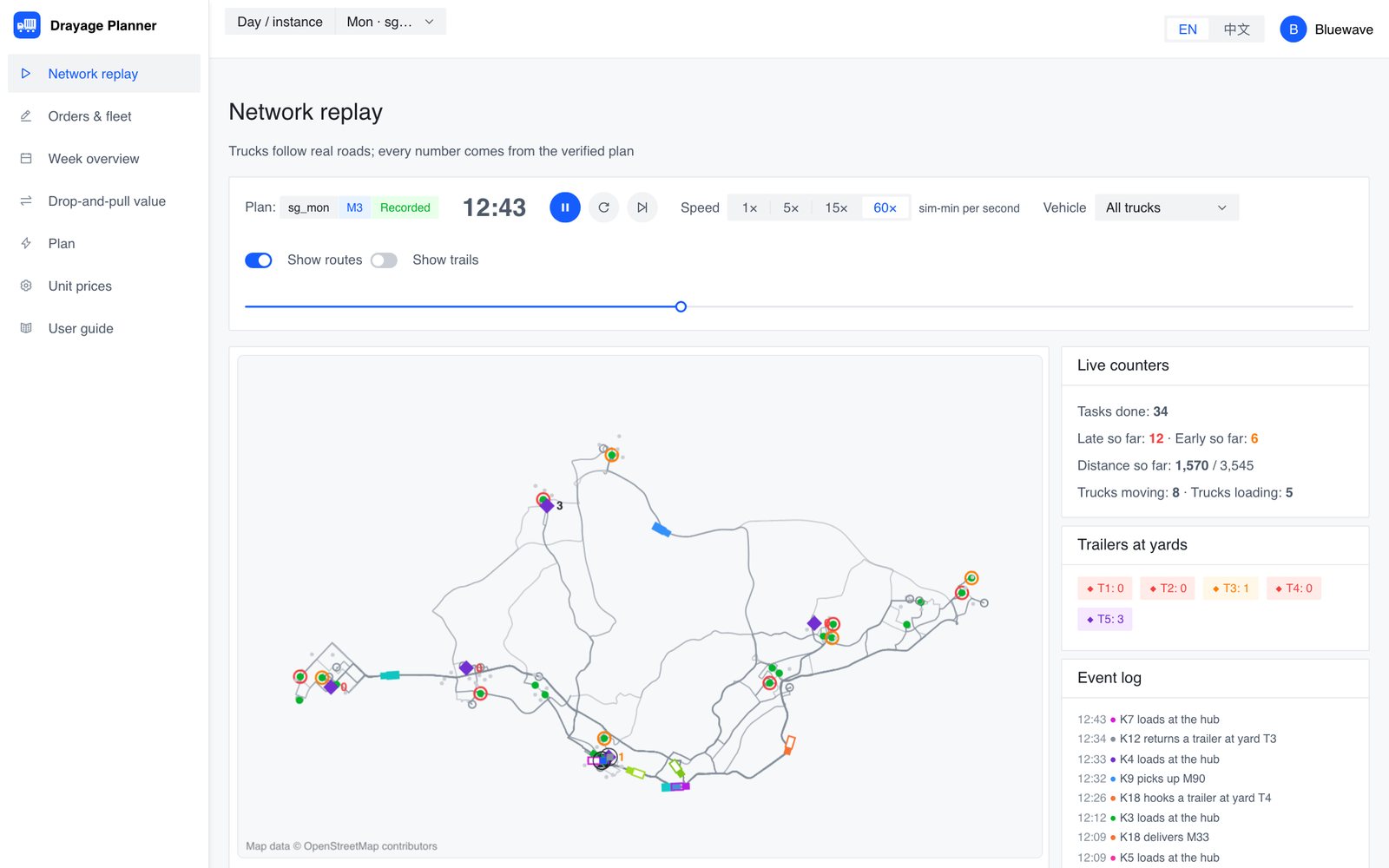
- Plans can be replayed on Singapore's real road network, while small-scale exact optimization provides a benchmark for solution quality
Every plan checked. Every cost explained.
Explore the Live Demo
Compare operating modes, adjust assumptions, visualize truck movements, and explore the trade-off between planning speed and solution quality.
Decision-support demonstration using fictional company data and assumed operating costs. Results are illustrative and are not production dispatch recommendations.